Anecdotal vs. Analytical Decision Making: Why Leaders Need Both
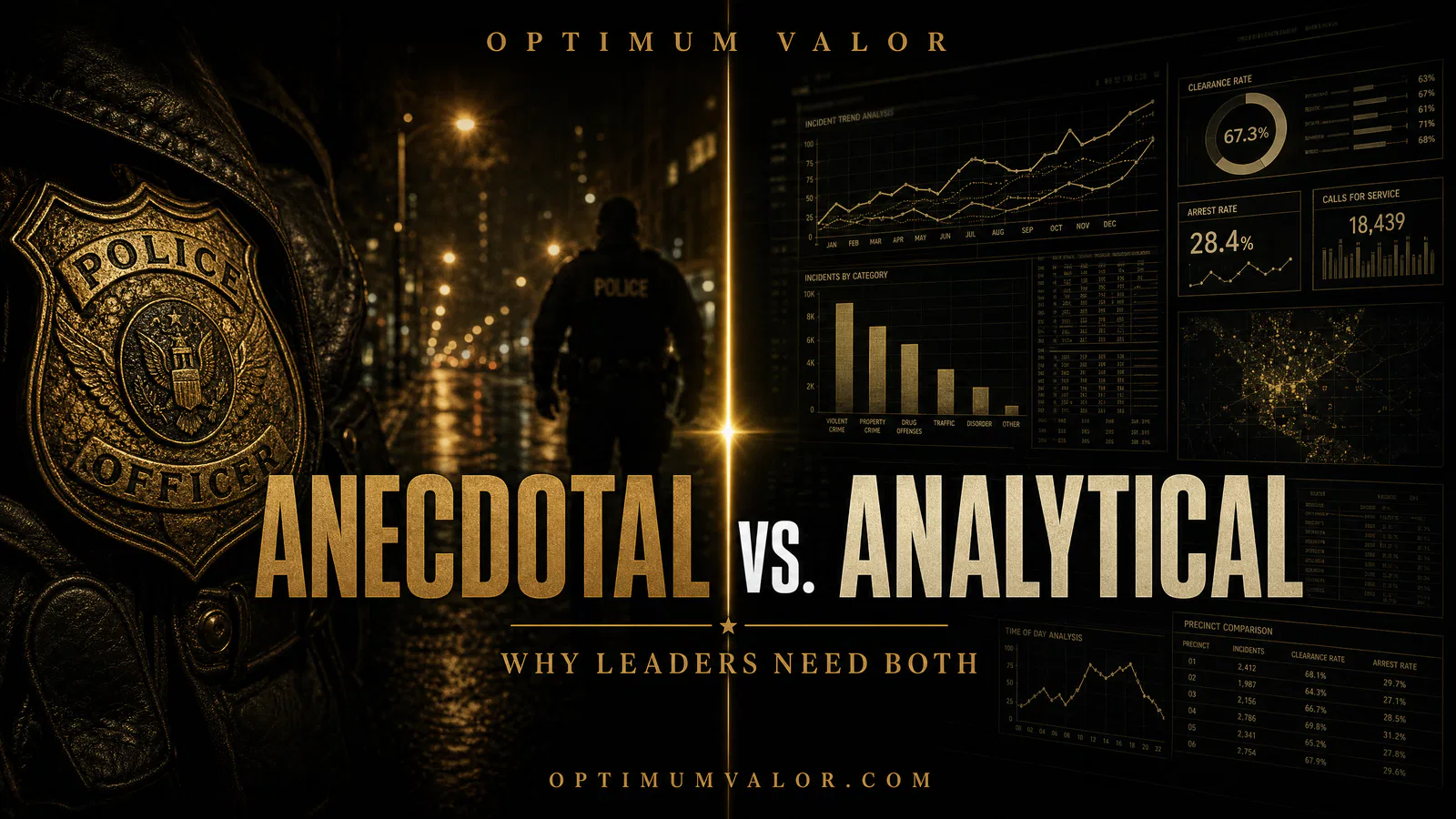
Every leader makes decisions with two forces pulling on them.
One side says, "I've seen this before."
The other side says, "Show me the data."
Both matter. Both can save you. Both can burn you if you use them wrong.
In public safety, leadership, fitness, business or life, the best decisions usually do not come from pure instinct or pure spreadsheets. They come from knowing when experience is enough, when data is required and when the two should challenge each other. Good decisions also include knowing when not to solve the problem yourself.
What is Anecdotal Decision Making?
Anecdotal decision making is when you rely on personal experience, stories, past events, memory or what people around you have seen.
That kind of thinking is not automatically wrong. Experience is valuable. Street knowledge is valuable. Pattern recognition is valuable.
A seasoned officer, coach, parent or executive can see things that a spreadsheet may miss. They can read human behavior. They can sense tone. They can recognize when something looks off before the numbers catch up.
That matters.
The problem starts when one story becomes the whole truth.
The Upside of Anecdotal Decisions
Anecdotal decision making is fast. That is its greatest strength.
When time is short, you may not have the luxury of gathering every data point. A supervisor managing a tense call, a coach adjusting a workout mid-session or a leader handling a personnel issue may need to act now. Promotional candidates get tested on this in the in-basket exercise.
Experience helps you move.
Anecdotes also carry context. Data may tell you arrests increased, crashes dropped or staffing was sufficient on paper. A person with firsthand experience may tell you the deployment worked only because two people stayed late, one supervisor filled a gap and the plan barely held together.
That is real information.
Anecdotes also bring the human element into the room. Numbers can tell you what happened. People can often tell you why it happened.
The Downside of Anecdotal Decisions
Here is the danger: anecdotes feel true because they are personal.
A story that happened to you carries weight. Sometimes too much weight.
One bad pursuit, one great employee, one failed program or one memorable incident can distort how you see everything after it. That is where leaders get trapped.
The common traps are simple:
You remember the loudest example, not the most common one. You assume your experience is everyone's experience. You use one failure as proof that a whole strategy does not work. You listen to the most confident person in the room instead of the most informed one. You protect an old belief because changing your mind feels like admitting you were wrong.
That is how organizations get stuck. They confuse memory with evidence.
What is Analytical Decision Making?
Analytical decision making uses data, trends, measurements, reports, history and structured review.
This type of thinking slows the room down. It forces discipline. It keeps leaders from building policy, staffing plans or operational decisions on whoever tells the best story.
In the vehicle pursuit safety discussion, this tension was clear. A speed restriction may feel anecdotal if someone says, "No crash happened at that speed, so why is that the line?" But the analytical question is bigger than one crash. It asks what happens across many pursuits when speed, traffic, offense type, officer control, roadway conditions and public risk stack together.
That is the value of analysis. It widens the lens.
The Upside of Analytical Decisions
Analytical decision making protects leaders from emotional overreaction.
It helps separate what is true from what is loud.
It gives you a defensible reason for your decision. That matters in leadership. Especially in public safety. When you move resources, change a tactic, adjust a policy or hold someone accountable, you need more than "I felt like it."
Analysis also exposes patterns that people miss.
Maybe a shift feels busy, but the calls for service show another shift is carrying the heavier load. Maybe an area feels dangerous, but the injury crash data points to a different corridor. Maybe people believe pursuits are failing because officers are driving too fast, but the review may show the bigger issue is unclear supervisory control, weak articulation, poor termination decisions or failure to set expectations early.
Good analysis does not just answer the question. It improves the question.
The Downside of Analytical Decisions
Data can make people arrogant.
That is the trap nobody wants to admit.
A dashboard can look clean and still miss the truth. A report can be accurate and still lack context. A trend can be real and still be interpreted wrong.
Data can lag behind reality. By the time the numbers prove the problem, the people closest to the work may have been warning about it for months.
Analysis can also become a hiding place. Some leaders use "we need more data" as a way to avoid making a decision. They keep asking for another report, another meeting and another review because they do not want to own the call.
That is not leadership. That is delay with a spreadsheet.
The other trap is measuring what is easy instead of what matters. Arrest numbers, citations, response times, workouts completed, sales clicks or attendance counts may be useful. But they do not always tell you if the mission is being accomplished.
Numbers need judgment.
When Anecdotal Decision Making May Be Better
Anecdotal thinking is useful when speed matters, context is limited or human behavior is the main variable.
It works well when you are making an immediate tactical adjustment. When you are dealing with a person, not just a process. When you need early warning before formal data exists. When you are trying to understand how a decision is affecting morale, trust or execution. When you are listening to experienced people who are close to the work.
In those moments, experience is not the enemy. It is a sensor.
But treat it like a sensor, not a verdict.
When Analytical Decision Making May Be Better
Analytical thinking is better when the decision affects many people, creates policy, shifts resources or will be judged later.
It works well when you are changing staffing. When you are evaluating a recurring problem. When you are reviewing a pursuit, use of force or critical incident. When you are deciding where to deploy people. When you are building a training plan. When you are spending money. When you are creating standards that others must follow.
The bigger the impact, the more disciplined the decision process should be.
Anecdotes can start the conversation. Analysis should shape the final call.
The Real Leadership Trap
The biggest trap is picking one side and worshiping it.
Some leaders worship experience. They dismiss data because they have "been around." They think rank or years on the job makes their opinion automatically correct.
That leader becomes outdated fast.
Other leaders worship data. They dismiss the people doing the work because the numbers do not show the problem yet.
That leader becomes disconnected fast.
The best leaders do neither.
They listen to the story, then test it. They review the data, then ask what the data is missing. They respect experience, but they do not let experience go unchecked. They trust analysis, but they do not let analysis replace judgment.
A Better Decision Model
Use this simple test before making a major decision:
What do people say is happening? What does the data say is happening? Where do the two agree? Where do they conflict? What could we be missing? What decision can we defend if this gets reviewed later?
That last question matters. Not because leadership should be scared. Because leadership should be clean.
If you are reviewing a vehicle pursuit, you cannot rely only on "it felt justified." You need the original reason for the stop, the offense, the speed, the conditions, the radio traffic, the supervisor's direction, the available tactics, the termination decision and the outcome.
If you are changing staffing, you cannot rely only on "this shift feels short." You need calls for service, peak hours, officer availability, workload, special events and the impact on base operations.
If you are creating a fitness, wellness or leadership plan, you cannot rely only on what worked for you. You need to know the person, the goal, the baseline, the obstacles and the evidence of progress.
Same principle. Different arena.
Final Thought
Anecdotes give decisions a heartbeat.
Analytics give decisions a backbone.
You need both.
Anecdotal decision making without analysis becomes bias dressed up as experience. Analytical decision making without human context becomes sterile, slow and sometimes flat-out wrong.
Strong leaders know the difference. They do not let one story run the whole organization. They also do not let a dashboard blind them to what their people already know.
Experience should raise the question. Evidence should sharpen the answer. Judgment should make the final call.
Go Deeper: The Oral Board Domination Guide
I've sat on the scoring side of the table. Most candidates don't fail because they lack experience. They fail because they walk in without a structure. The Oral Board Domination Guide is the system I built to fix that: how to organize your answers, handle the scenario questions, and sound like a supervisor instead of a patrol cop.
Get The Oral Board Domination Guide on Kindle
Antonio M. Scott is a Lieutenant with the Las Vegas Metropolitan Police Department and the founder of Optimum Valor. He specializes in leadership development, performance optimization, and building resilient first responders.
(If this content helped you think differently about leadership, consider supporting the mission so we can keep providing free resources to the first responder community: Support Optimum Valor on Ko-fi)
STAY ON MISSION
Get the free End-of-Shift Recovery Checklist
Join the list and I'll send you a 2-page checklist to come down from the shift and walk in the door present.